Before getting Nofence
How shelter beacons work
How shelter beacons work
How shelter beacons work
How shelter beacons work

What is a shelter beacon? And why might you need one?
Barns and sheds can interfere with GPS signals. When signals bounce off a roof or walls, the collar on your livestock may log an inaccurate position.
If that position falls outside the virtual boundary, the collar could emit an audio warning or pulse, even though the livestock is safely inside. In these situations, the collar battery also drains faster because the collar position continuously drifts or jumps around.
Shelter beacons solve this by temporarily disabling the GPS receiver when a collar is within range of the beacon. By installing a shelter beacon, you will reduce the risk of seeing inaccurate positions and getting unwanted warnings.
How shelter beacons work
The shelter beacon connects to the collars via Bluetooth. When a collar is in range, the GPS receiver switches off and the collar is marked as being in a safe zone. Once the livestock leaves the beacon's range, the GPS receiver turns back on automatically.
You'll see a shelter icon in the app when a collar is connected to a beacon. To use this feature, turn on beacon scanning for any pasture that includes a shelter beacon. To do this, go to Pastures > Select pasture > Beacon scanning > Scanning: ON. You will also be able to see the beacon icons on your main Status map view.
Installation
The beacon is simple to install and can be purchased from the Nofence store. The beacon device requires two AA batteries, which are included with the beacon when purchased. The beacon has a very long battery life, and can last for years.
The shelter beacon range is around 5 meters. Walls and other objects can block the signal. This means the range might be shorter or less steady. To check the exact reach, carry a collar around the area and watch for the beacon symbol to appear in the app.
Quick to set up: Installation takes around 2 minutes. You can attach the beacon using double-sided adhesive or/and screws (you will need a screwdriver).
How many beacons should be installed?
In larger rooms, we recommend using at least two shelter beacons. However, as every building and shed is unique, the final number of units required should be decided between the seller and the buyer to ensure full coverage.
If the livestock often lie down alongside the outside walls of the building, you should also consider placing shelter beacons on the inside of those walls.
Positioning your shelter beacon
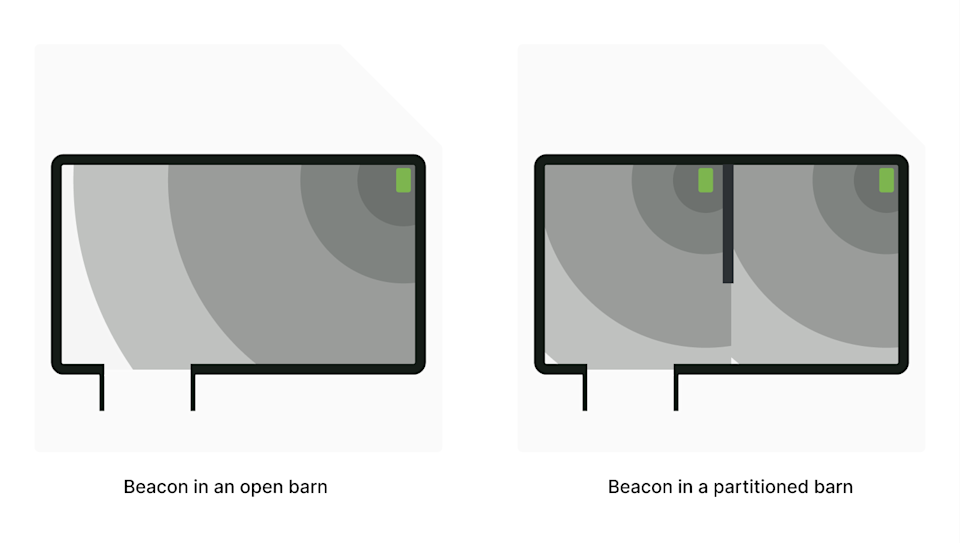
Shelter beacons are designed for indoor use only. Always ensure that the beacon is not overlapping with the virtual boundary. If the beacon is placed too close to your virtual boundary, it can create a gap in the fence where livestock could leave without receiving a warning. To avoid this, either move the beacon further into the building or move the virtual fence line further from the shelter. If your building contains walls or partitions, we recommend using multiple beacons, as shown.
Troubleshooting
If beacon batteries are empty, the collars will stop detecting the beacon. To change batteries, remove the beacon from the wall, unscrew the bottom panel of the beacon, and replace the batteries. If you encounter further technical problems with the beacon, contact support.