Setting up Nofence
How to train your herd
How to train your herd
How to train your livestock
How to train your livestock
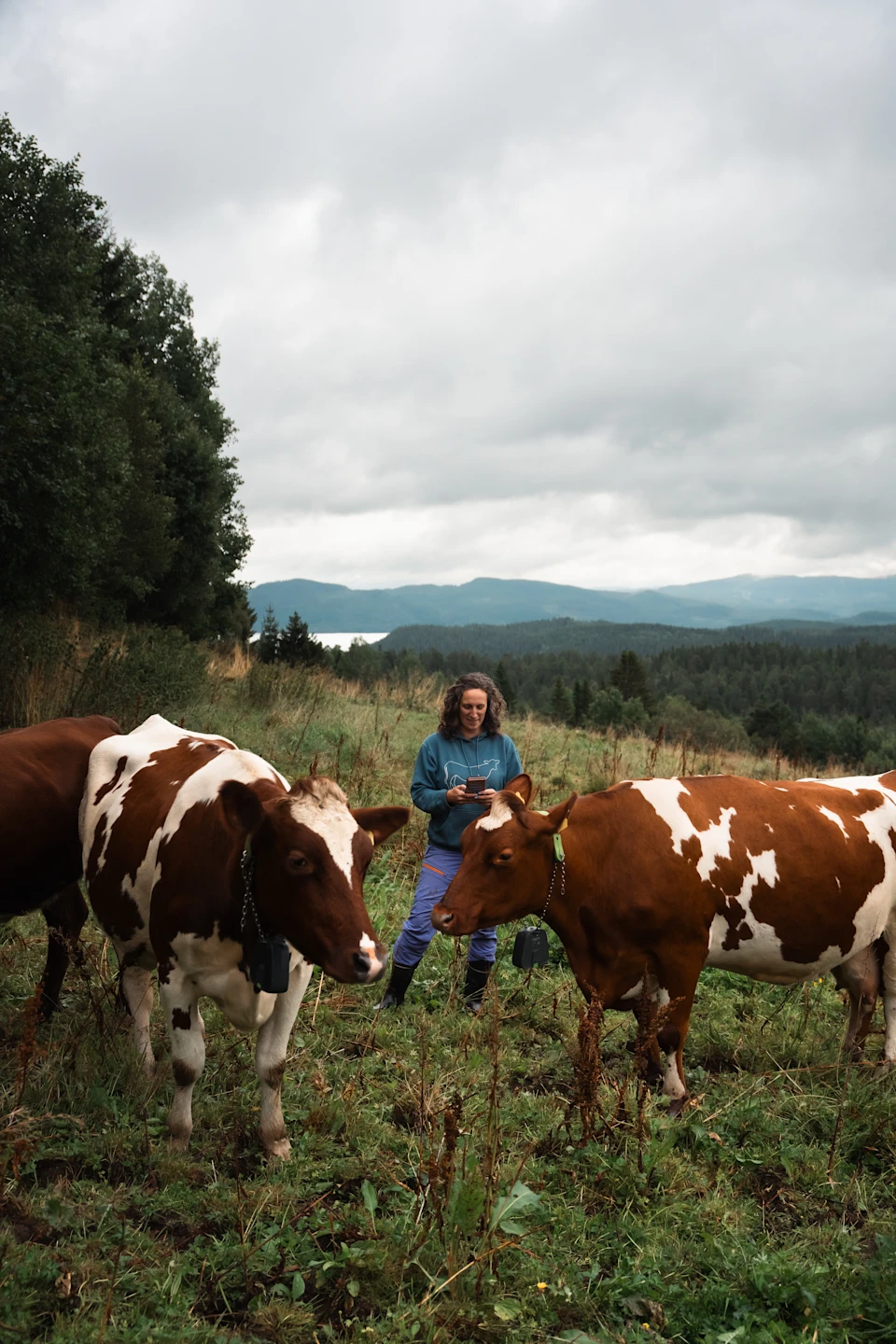
The Nofence training system is designed to be simple and effective. This guide will help you and your herd adapt to virtual fencing quickly and responsibly.
A note about animal welfare and the importance of training
For the well-being of every individual in your herd, it is essential that the learning process is planned and well-organised. When the farmer has prepared well for the training, the livestock experience fewer electric pulses. Good training also reduces the risk of escape, and improves the well-being of your herd. See a short video here about training here: Video : https://youtu.be/yIQtoWId0vs
Are you new to keeping livestock? Make sure to allow your animals enough time to get to know their new grounds before embarking on the virtual fence training. The animals should know and feel safe in the area where the training takes place. This period will depend on several factors, such as the make-up of the herd and the individuals in it.
Before you start the training process
Training must take place in a location with satisfactory mobile and GPS coverage. If you have any doubts, you should conduct a test by walking around with a collar in your hand. The animals must have a sense of security in the area where the learning takes place. Let them spend time getting acquainted with the area before the training starts.
We recommend creating the training pasture somewhere you can monitor the animals’ progress. By observing the animals during the training period, you learn how they respond to the system.
All adult animals must wear a collar to safeguard animal welfare. In herds where some animals wear collars and others do not, the animals wearing collars will ignore both audio warnings and electric pulses in order to follow the herd.
The training pastures should be small enough for the animals to encounter the Nofence boundary during the training, but large enough for the animals to run about.
Training pastures that are too big will result in few encounters with the audio warning and the training will take longer.
If the training pasture is too small the animals can become restless, as they will meet a new boundary in the attempt to get away from another. Give them enough room to run about.
Step 1: Draw a training pasture inside a physical boundary
First, make sure you have charged and fitted your collars. Once you’re ready, draw your first training pasture inside an existing fenced paddock. Layer the virtual fence directly over your physical fence or poly wire. This gives your livestock a familiar boundary to fall back on while they get used to hearing the audio cues. You can do this training for about 1 to 2 days.
Understanding training pastures vs. regular pastures
A training pasture is a dedicated practice area created in the Nofence app. The livestock will learn the virtual boundary regardless of where you start them. Training pastures give you better results by making the learning process clearer and faster.
When a collar is assigned to a training pasture, teach mode is activated automatically. Every time a collar is assigned to a training pasture, teach mode resets and starts over again. When a collar is assigned to a regular pasture, the collar goes directly into regular mode, which is the normal mode the collars should be in when the livestock are properly trained.
Understanding teach mode
Teach mode is designed to help animals understand the Nofence system step by step:
The warning sound stops immediately when the animal turns its head back towards the pasture.
The sound always restarts at the lowest pitch when it begins again.
Teach mode ends automatically after 20 correct reactions (the animal turns back without receiving a pulse).
This way, animals learn to associate the sound with turning back before experiencing a pulse.
Note: In teach mode, the audio warning is more easily switched off than it would be in regular mode, helping the animal learn faster. As a producer, you may notice that the pasture boundary feels less accurate in teach mode. This is because the animal can move farther past the boundary than it can when in regular mode.
Step 2: Redraw the virtual boundary into the fenced area
After about 2 days, you can redraw the training pasture so it sits inside the paddock, about 5-10 metres inside from the physical fence. This lets your herd experience the virtual boundary on its own, without a physical backup.
Step 3: Redraw the virtual boundary so that it cuts off part of the existing pasture area
On day 3-4, we recommend training by cutting off a part of the pasture; this way, as the animal is grazing they will have to cross the boundary to learn how the system works.
There should be plenty of space outside the Nofence boundary (at least 160 ft / 50 metres) so that they have the ability to escape the virtual boundary, and then have some space before encountering the physical fence on the opposite side.
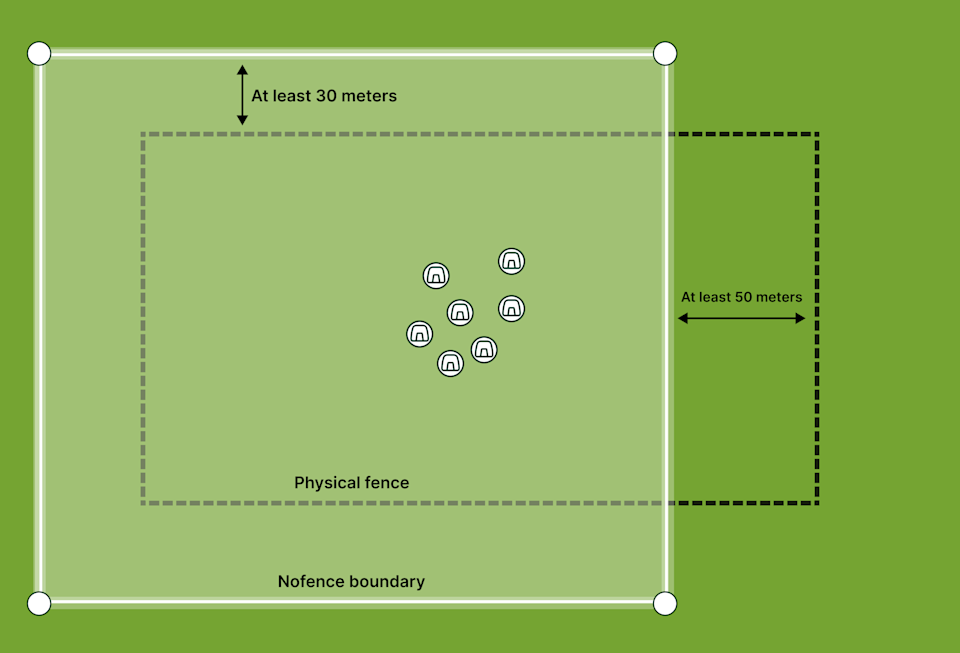
In general, we recommend that you don’t make frequent changes to the Nofence pasture at the beginning of the training process. A stable and logical boundary makes for a more efficient learning process. However, it’s also important that the animals understand that the boundary can and will move and change. We recommend, for example, changing the boundary only once during the first two days, and then changing the boundary twice a day during the rest of the training process.
Over time, you'll see your livestock start to respect the virtual boundary. They'll turn back after hearing the audio cue, well before reaching the fence line.
What kind of livestock behaviour to expect during training
When you start training your animals and they receive an electric pulse for the first time, they may back up into the herd, or sometimes they may try to escape. In the instance of an escape, you should be ready with some grain to lure animals back into the Nofence pasture. It is important that you are present during the learning process until you observe that the animals respect the audio warning and turn around when the scale starts playing.
The most important aspect of the training process is that the animals learn that they can turn the audio warning off by turning and going back into the Nofence pasture. Therefore, it is important that the boundaries are set in a manner that makes them logical to the animals. Create a simple pasture with simple boundaries.
How long does the training take?
Most animals will understand the relationship between the audio warning and delivery of the electric pulse during the first three days of the training. When you see that the animals in the herd are well-acquainted with the system and turn around when they hear the audio warning, you can consider removing the physical fence from the training pasture. As a general rule, the animals should spend 1-2 weeks on the training pasture before they are given a fully virtual pasture.
When the animals have learned to master the connection between their behaviour and the audio warning, they can be moved to new pastures without using physical fences.
Why should you collar the whole herd?
It might seem logical to only collar the dominant members and let herd instinct do the rest. Our research shows this doesn't work the way you'd expect. When a collared dominant member learns the boundary, dominance often shifts to an uncollared member of the herd. The group then follows the uncollared leader, and your virtual fence loses its effect. Collaring the whole herd ensures every member learns and understands the boundary.
Do I have to retrain the livestock every season?
No. Once the herd has learned virtual fencing, most producers report that they will continue to understand the system from season to season. If you introduce new untrained livestock to the herd, we recommend training them to reduce any unnecessary learning difficulties and disrupting your already trained herd.
If you see a member of the herd that, after initial training, is testing the virtual boundary too much, consider moving them back into the training pasture. On occasions, animals may be deaf, which can also reduce the effectiveness of the system, although this is rare.
What about when the herd has calves, kids or lambs? Do I need to train them?
Usually, no. We find that livestock that are born in a herd tend to learn the virtual fence and how it works by early exposure. We don't recommend collaring immature livestock until they have developed, but we notice that they never stray too far from their mothers.
Young individuals become ready for a collar when they have reached a certain physical size (especially for smaller breeds) and when they are mentally mature enough to learn the system. Most young livestock that have followed their mothers already understand how it works. Knowing when to collar young animals is a decision that’s up to the producer, and dependent on any local regulations that may apply.